Location: On an island of Rameswaram in Ramanathpuram district
, Tamil
Nadu
Dedicated to:
Sri Ramanathaswamy (Lord Shiva)
Attraction:
Twenty two wells
Ramanathaswamy Temple is an important pilgrimage site
for the followers of Hinduism. It is believed that a visit to this
temple washes away one's sins and brings salvation (moksha). Located on
an island off the Sethu coast of Rameshwaram, Ramanathaswamy Mandir can
be reached via Pamban Bridge across the sea. Being situated in
Rameswaram, the shrine is popularly known as Rameshwaram Temple.
Rameswaram is a town in Ramanathpuram district of Tamil Nadu. The town
is particularly famous for its religious shrine of Ramanathaswamy. The
nearest airport to Rameshwaram is located at Madurai, which lies at a
distance of 163 kms. One can easily reach Rameshwaram by taking regular
tourist buses or by hiring taxis from all the major cities of Tamil Nadu
including Madurai, Chennai and Trichy.
The construction of this temple began in the 12th century; nonetheless
it was completed much later, during the reign of various rulers.
Rameshwaram Temple is famous for embracing one of the twelve
Jyotirlingas (lingam of light) of Lord Shiva. The temple is also
accredited for being the southern most 'jyotirlinga' of India. It is
believed that at this place Lord Rama offered his gratitude to Lord
Shiva.
The Lingam of Ramanathaswamy is the presiding deity of Rameswaram
Temple. The religious significance of this shrine has made it, one of
the most visited temples of India. Rameshwaram (South) is one of the
four major pilgrimage sites of Hindus, the other being Puri (East),
Dwarka (West) and Badrinath (north). The main shrine adores the idols of
Viswanatha Naicker and Krishnama Naicker.
In the inner section of the Ramalingeshwara, Ramalingam and Vishvalingam
are placed side by side. Preserving the words of Lord Rama, Vishvalingam
is worshipped before Ramalingam. Maha Shivarathri, Thirukalyanam,
Mahalaya Amavasai and Thai Amavasai are the major festivals that are
celebrated with gusto and fervor.
Location:
Jammu
Built by:
Started by Maharaja Gulab Singh, Completed by Rambir Singh
Built in:
During 1835-1860
Dedicated to:
Lord Rama
Raghunath Temple is a well-known holy shrine of the
Hindus. Located in Jammu, Raghunath Mandir is one of the largest temple
complexes of the Northern part of India. The temple is dedicated to Lord
Rama, who is believed to be an incarnation of Lord Vishnu. In 1835, the
construction of this temple was started by the founder of Jammu &
Kashmir, Maharaja Gulab Singh. After the death of Gulab Singh, it was
completed by his son, Maharaja Rambir Singh in 1860. One can easily
reach this temple from Srinagar/ Jammu Airport by hiring taxis or by
taking regular buses from the cities.
The huge temple has seven shikhars (spires), where every shrine has its
own shikhar. On the very entrance of the Temple, a portrait of Maharana
Ranbir Singh and an image of Lord Hanuman embellish the site. The
central shrine is dedicated to Lord Raghunath/ Rama, who is the
presiding deity. Apart from the main shrine, the other shrines encompass
various incarnations of Lord Vishnu. There is a shrine of Lord Surya
(Sun God), which is another striking shrine. There are many idols of
different forms of the God.
Inside the temple, there are other shrines that house huge statues of
the Hindu Gods and Goddesses. It is noteworthy to mention that gold
sheets cloak the interior walls on three sides of this temple. It also
has a gallery, where various 'Lingams' (phallic form of Lord Shiva) and
'Saligrams' are placed. Raghunath Temple comprises almost all the images
of the Hindu Pantheon, which is quite uncommon. The sermons and rituals
of the temple include both morning and evening Aarti.
A glimpse of Mughal artistry can be seen in the architecture of
Raghunath Temple. The carvings and arches are really beautiful and grasp
the major attention. There is a library in the temple complex, where
rare Sanskrit manuscripts are kept. People visit this temple in large
numbers to pay their homage to the deity and get the blessings from the
God.
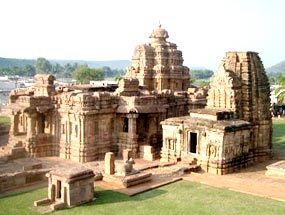
Location:
Pattadakal, Near Badami and Aihole, Karnataka
Built by:
Chalukya Rulers
Built in:
During 7th- 8th century
In
Karnataka, Pattadakal is a small town that is renowned for its ancient
temples. Located near Badami and Aihole, Pattadakal Temple can be easily
reached by regular buses or private taxis from the major towns and
cities of Karnataka. The Temples of Pattadakal, exhibhit the zenith of
'Vesara' style of Hindu temple architecture. Owing to its incredible
temples, Pattadakal was titled a World Heritage Site by UNESCO in 1987.
Pattadakal had once been the rich capital of the Chalukyas. During 7th
- 8th century, Pattadakal Temples were got constructed by the Chalukya
rulers. Portraying the rare specimen, the temples depict a wonderful
blend of Dravidian (South-Indian) and Nagara (North-Indian)
architectural styles. The phrase 'beauty in ruins' goes exactly with the
town of Pattadakal. The beautiful settlement appears majestic with its
series of nine temples.
The sculptural art of these temples is marked by classiness of the
Chalukya dynasty. Pattadakal emerges as a heavenly site with its superb
architectural marvels in a picture-perfect lane. The distinct styles and
patterns of various temples reveal the designers' intelligence at a
stretch. The temples of Pattadakal receive myriad number of tourists,
who come from the distant lands, round the year.
Out of all, four temples are built in Dravidian style, four in Nagara
style and Papanatha Temple illustrates a perfect blend of both styles of
architecture. In the 8th century, Kashivisvanatha Temple was constructed
by the Rashtrakutas. Built in north Indian style, Galganatha Temple
encompasses a sculpture of Lord Shiva killing the demon Andhakasura.
Kasi Visweswara is another temple that boasts of the nagara style of
architecture. The important ones are discussed below in detail.
Location:
In Osian, Near Jodhpur
Built in:
During 8th -11th century
Dedicated to:
Lord Mahavira, Sachi Mata, Lord Surya
The ancient city of Osian is famous for its
architectural temples that date back to medieval age. Located at the
verge of the Thar Desert, Osiyan can be easily reached from anywhere in
Rajasthan. Osian is accessible from Jodhpur that lies at a distance of
65 kms in the north-west. However, one can reach Osiyan Temples by
taking regular buses or by hiring taxis. Ossian has not less than 100
temples belonging to the sect of Hindus and Jains.
The city of Osiyan is said to have founded by Utpaladeva, who was a
Rajput Prince belonging to Pratihara Dynasty. In those times, the city
was named as Ukesha or Upkeshapur. During the Pratihara dynasty, Osian
is believed to be the major religious and cultural centre of the Mewar
kingdom. A major number of shrines are devastated with the ravages of
the time, however 18 shrines are still there unfolding the royal legacy
of past.
Amongst these temples, Surya (Sun) Temple, Harihara Temple, Sachiya Mata
Temple and a Jain temple dedicated to Lord Mahavira get the prime
importance. Osian is regarded as a prominent pilgrimage site for Oswal
Jain community. Ravages of the time have destroyed these temples to an
extent, still their charm attract people to visit the ancient city of
Ossian.
Location:
22 kms from Swarg Ashram in Haridwar
Dedicated to:
Lord Shiva
Neelkanth Temple is one of the most revered holy
shrines of the Hindus. Located on a hill above Swarg Ashram in Haridwar,
Neelkanth Temple is easily accessible from here. The temple lies at a
comfortable distance of 12 kms and can also be reached from Rishikesh.
The way to this temple is surrounded by lush green hills and rivers,
providing some of the most beautiful sights, one has ever seen. Many
pilgrims come to this temple by trekking, which takes around 4 hours
from Rishikesh.
Neelkanth Mahadev Temple is dedicated to Lord Shiva, who is believed to
be the most complex Gods of the Hindu pantheon. The establishment of
this temple has a legend behind it. According to the mythological
stories, Lord Shiva drank the poison that appeared from the 'Sagar
Manthan' (churning of ocean). This place is said to have been the same
place, where Lord Shiva drank the poison. On drinking the poison, his
throat turned blue and from that time onwards, Lord Shiva came to be
known as 'Neelkantha' (One having blue throat).
Encircled by the hills of Manikoot, Vishnukoot and Brahmakoot,
Neelkantha Temple is to be found at a height of 1330 meters. The way to
this shrine is quite a thrilling one. The steep and narrow roads, taking
above the hill, where river is flowing on one side, send chills down to
the spine. Positioned at the union of Madhumati and Pankaja rivers,
Neelkantha Temple is placed between the picturesque hills of
Uttaranchal.
The temple complex has also got one natural spring where devotees
usually take a holy bath. The main shrine of the temple comprises a
Shiva lingam (phallic form of Lord Shiva). The spiritual aura of the
temple creates a devotional feeling in the hearts of people. People make
an offering of coconut, flowers, milk, honey, fruits and water to the
Lord. Subsequently, devotees get 'Parshad' of vibhuti, chandan and other
things from the shrine.
The temple observes two fairs that held annually on the occasion of
Shivratri (Feb-Mar) and Shivratri of Shravan (July-Aug). At that time,
the temple is thronged by thousands of pilgrims. This place is also
loved by tourists for its picturesque beauty. Neelkanth Temple is a holy
place that provides a celestial affection to the people, who visit the
shrine with a devoted heart.
Location:
At Prithviraj Marg, Ajmer
Built in:
1865
Dedicated to:
Lord Adinath
Attraction:
Museum with gilded sculptures
The renowned Nasiyan Jain Temple is to be found at
Prithviraj Marg in Ajmer, Rajasthan. After the temples of Ranakpur and
Mount Abu, Nasiyan temple is regarded as one of the best Jain temples in
Rajasthan. Built in 1865, Nasiyan Temple is also known as Lal Mandir
(Red Temple). Centrally located in Ajmer, the temple can be reached
easily from anywhere in Rajasthan. Nasiyan Digambar Jain Temple is
dedicated to Lord Adinath, the first Jain 'tirthankara'.
The two-storied structure of Nasiyan Temple is divided into two parts,
where one is the worship area comprising the idol of Lord Adinath and
the second is the museum including a hall. The museum hall gets the
major attention due to its mind blowing interiors made up in gold. This
exquisite museum depicts the five stages (Panch Kalyanak) in the life of
Lord Adinath, in the stature of statues. With the dimensions of 40 x 80
feet, the hall is adorned with Belgium stain glass, mineral color
paintings and stain glasswork.
The astonishing and inimitable display of the shrine, made it to be
recognized, as the Golden Temple (Swarna Mandir). The focal hall is made
surprisingly beautiful with gold and silver decorations. Digambar Jain
Temple displays marvelous wooden gild representations, glass engravings
and paintings, recounting the conviction of the Jainism with reference
to the making of the world. Festooned by precious stones, gold and
silver work, the place is also termed as Soni Ji Ki Nasiyan.
The celestial appearance of the temple creates a kind of divine aura
that appeals to the mind of pilgrims and devotees. In the inner prayer
chamber, small silver balls hanging from the ceiling absolutely enthrall
the onlooker. The posh interiors of the temple boast of the aesthetic
and rich taste of the Digambar Jains. In the vein of other Jain
architecture, Nasiyan Temple has high fortifications encircling the
temple complex. Jain Temple receives devotees, who come to pay their
homage to Lord Adinath, from all over India.
Location: On a hill top in Bilaspur district
of Himachal Pradesh
Dedicated to: Naina Devi (
form of Goddess Shakti)
Naina Devi Temple is a holy shrine that is dedicated
to Shri Naina Devi, one of the forms of Goddess Shakti. Located on the
top of a hill in Bilaspur district of Himachal Pradesh, Naina Devi
Mandir is one amongst the fifty one Shakti Peeths. The Temple of Naina
Devi is a famous temple, connected to the National Highway No. 21 for
the facility of pilgrims. The hill can be reached through a road by
vehicles and to reach the summit, one can opt for concrete steps or
cable car.
Naina Devi Temple is a sacred place especially for the Hindus. Pilgrims
come to visit this temple to pay their homage to the Goddess. According
to the legends, the different body parts of Sati fell on the earth
during the time of self-sacrifice. It is believed that Sati's eyes fell
at this point and subsequently, a temple was built here to commemorate
the goddess. The term 'Naina' suggests 'eyes', so the goddess came to be
known as Naina Devi.
In the temple complex, there is huge Peepal tree that is acclaimed to be
present from past many centuries. On the right side of the entrance to
the main shrine, idols of Lord Hanuman and Lord Ganesha are placed.
After crossing the main gate of the shrine, two striking statues of
Lions are visible. The main shrine reveals the images of three deities.
Goddess Kali can be traced on the extreme left. In the centre, image of
Naina Devi is visible, while Lord Ganesha is on the right side.
The Temple is perched over a small yet scenic hill. From the suburbs of
the temple, one can spot the picturesque Govind Sagar Lake. Close to the
main shrine, there is a small cave, which is known as Shri Naina Devi
Cave. In the earlier days, people used to trek the steep path of 1.25
kms to reach the temple at the hill-top. Now, the facility of cable car
has been launched to make to journey easy and enjoyable. On Shravan
Ashtami, a big fair is held annually at this temple. During the time of
Navratras, the temple is visited by large number of people.