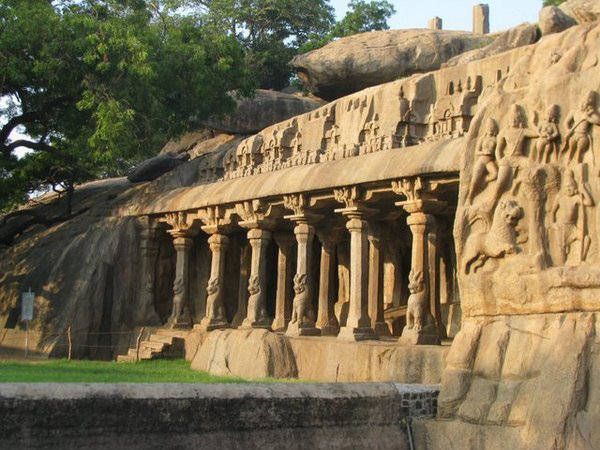
Friday, 30 September 2011

Shore Temple


Location: Mahabalipuram, Tamil Nadu
Built in: 7th century  
Dedicated to: Lord Shiva and Lord Vishnu
Attraction: One of the earliest structural temples in South India  


Shore Temple is a standing testimonial to the regal heritage of India. Located at Mahabalipuram, Shore Temples can easily be reached by taking regular buses or by hiring taxis from anywhere in Tamil Nadu. The nearest airport is located at Chennai that lies at a distance of 60 kms from Mahabalipuram. One of the most photographed monuments in India, Shore Temple is a structural monument on the shores of Bay of Bengal.

Built in the 7th century, Shore Temple depicts the royal taste of Pallava dynasty. During the reign of Rajasimha, the temple saw its construction when Pallava art was at its apex. Ravaged by wind and sea, the temple has witnessed the historical events of India. This work of genius was recognized and listed amongst the World Heritage Sites by UNESCO.

Shore Temple comprises three shrines, where the prominent ones are dedicated to Lord Shiva and Lord Vishnu. In the garbhagriha (sanctum sanctorum), an image of Shivalinga embraces the site. At the rear end, one can find two shrines facing each other. Here, one shrine is dedicated to Ksatriyasimnesvara and other to Lord Vishnu. In the shrine, Lord Vishnu is imaged reclining on the 'Seshanag', which is a symbol of consciousness in Hinduism.

The exterior wall of the shrine to Lord Vishnu and the internal side of the boundary wall are elaborately carved and sculptured. The images on the sculpted panels depict scenes from everyday life. However, the sculptures are incredibly real and artistic. The exterior walls of the temple are segregated by plasters into bays, where the lower part has been impressed into a series of nurturing lions. The archeological department has excavated certain other figures from the site.

Shore Temple is no more a living temple. The structure of the temple makes one to contemplate and perhaps, it was erected basically as a work of art. The Pallavas were known to be the great patrons of art and were keen to create their own style of temple architecture. In the present day, Shore Temple makes the background of Mahabalipuram Dance Festival that is held in Jan /Feb every year. The festival was organized to promote the traditional dance as well as tourism in Mahabalipuram.

Shakumbhari Devi Temple


Location: In Jasmour village of Saharanpur district , Uttar Pradesh
Built by: Maratha Rulers  
Dedicated to: Goddess Shakumbhari (a form of Durga)

Shakumbhari Devi Temple is an ancient shrine that is visited by numerous pilgrims round the year. This revered shrine is located in Jasmour village, which lies at a distance of 40 kms in the north of Saharanpur (Uttar Pradesh). Shakumbari Devi Mandir is easily accessible from Delhi through regular buses or private taxis. Perched in the midst of Shivalik mountain range, the temple is believed to have been built by the Marathas.

There is nothing extra-ordinary about the architecture of this temple, but the divine aura makes it different from others. Many devotees believe that no one goes empty handed from the shrine of the Goddess. It is alleged that Shakumbhri Devi is the slayer of the demon king, Mahishasur. According to the legends, Shakumbhari Devi did penance (tapa) for 100 years and had vegetarian meal only once at the month end.


As the legend goes further, the Goddess helped the living beings to sustain by having plants and vegetables, when there was no water on the Earth, for about 100 years. For the period of her penance, many saints (Rishi-Munis) came to have a glimpse of the Goddess. All the saints were well treated and offered vegetarian meals. Due to the fact that the Goddess eats
vegetarian food, she came to be known as Shakumbhari Devi.

As per the sayings, Sankaracharya came to this place and meditated here. He found the idols and placed them in the shrine. In the sanctum sanctorum, Shakumbhari Devi is enshrined in the company of Bhramari Devi, Bhima Devi and Sheetla Devi. In fact, all these goddesses imply the same 'Shakti' (Power) that incarnated herself in different forms at different intervals of time.


In the east of this temple, there is a shrine at a distance of one kilometer. This shrine is dedicated to Bhura Dev (Lord Bhairav), who is regarded as the guard of Shakumbhari Devi. It is said that a visit to this temple is a must, in order to complete the journey to Shakumbari Devi.

Festival
In the vein of other Goddess temples, this too observes great festivity during the time of 'Navratra'. At the time of Navratras of Ashwin and Chaitra, loads of pilgrims and devotees come to pay their homage to the Goddess and seek her blessings. The temple is getting popular day by day, due to its spiritual belongingness and aesthetic appeal.


Shankaracharya Temple


Location: On Gopadari Hill, in south-east of Srinagar
Built by: Raja Gopadatya
Built in: 371 BC
Dedicated to: Lord Shiva
Attraction: Ancient architecture


Shankaracharya Temple is an ancient temple that finds its origin in the 4th century. Located on Gopadari Hill in the south-east of Srinagar, Shankaracharya Temple lies at a height of 1100 feet above surface level of the city. The temple is easily accessible from the city by regular buses from Srinagar. In order to ensure a comfortable journey, one can opt for taxis that are readily available throughout the city.

In 371 BC, the temple is said to have been built by Raja Gopadatya. At that time, the temple was named as 'Gopadari', after the name of the King. It is believed that Shankracharya, the great philosopher, lived here during his trip to Kashmir. The legend left the place centuries ago, ever since, the temple came to be known as Shankaracharya Temple.


The
structure of the temple boasts about the architectural style of those times. However, many additions and changes have been made to the original structure. Erected on a high octagonal platform, the temple can be reached by a flight of steps. The fencing walls of the steps have some inscriptions on them. Inside the temple, there is a Persian inscription that dates back to period of Shahjahan.

The main shrine is in the shape of a circular chamber and provides a breathtaking view of the valley. After numerous repairs, the ceiling of the main chamber appears to be modern in its approach. Shankaracharya Mandir is regarded as the oldest temple in the valley of Kashmir. Throughout its life, the temple has seen many repair and renovation works.


The first work of renovation is considered to have taken place during the reign of Lalitaditya. When the temple got damaged in an earthquake, the second repairs were done by Zain-ul-Abideen, under the rule of Sheikh Mohi-ud-Din. The stone steps that lead to the main shrine, are known to be built by Maharaja Gulab Singh. In 1925, the facility of electricity was made possible at Shankracharya Temple.


Sankat Mochan Temple


Location: At Sankat Mochan Gali, Varanasi
Dedicated to: Lord Hanuman  

Sankat Mochan Temple is one amongst the most visited shrines of Varanasi, the holy city of India. Located at Sankat Mochan Gali (Street) in the southern part of Varanasi, Sankat Mochan Hanuman Mandir is highly revered by the followers of Hinduism. The temple can be reached easily by the means of local transport in the city of Varanasi. Sankat Mochan is the other name of Lord Hanuman; consequently the temple is dedicated to him.

The term 'Sankat Mochan' suggests "deliverer from troubles". According to the Hindu beliefs, Lord Hanuman is provider of courage, intellect and knowledge. Lord Hanuman is also believed to the eradicator of all worries and tensions. Sankat Mochan Temple was established by Tulsidas, the legendary author of 'The Tulsi Ramayana' (the Hindi version of epic "The Ramcharitmanas"). It is regarded that regular 'puja' (worship) of Lord Hanuman at this temple, brings good luck to the devotee.


People visit this temple in large numbers on Tuesdays and Saturdays to pay their homage to the Lord Hanuman. Since countless years, devotees come here to seek the blessings of the Lord. People apply "Sindoor" (vermilion) on the statue of Lord Hanuman and offer "Laddoos" in the offering. Devotees recite hymns of "Hanuman Chalisa ", "Kishkindha" and "Sundar Kand" as a due part of their prayers.


As per the Vedic Astrology, Lord Hanuman defends and liberates human being from the wicked effects of 'Shani' (Planet Saturn). All those, who have ill-placed Saturn in their horoscope, should offer homage at this temple to get relief from the distress. In the earlier times, the temple was very small in its size. Later, the temple complex was extended attributable to the kind donations made by the devotees.

Festival
On the day of 'Kartik Krishna Chaturdashi", special prayers are made to the Lord. The temple observes an annual festival on the full moon night of the month of 'Chaitra', which is also known as Hanuman Jayanti. At this juncture, a procession is taken out in the streets of Varanasi. The festival too, attracts plenty of visitors to Sankat Mochan Temple.


Sai Baba Temple Shirdi


Location: 58 kms from Manmad, at Shirdi in Maharashtra 
Dedicated to: Sai Baba

Sai Baba Temple is a holy shrine that is attracting millions of devotees from many years. Located at Shirdi in Maharashtra, Sai Baba Mandir is easily accessible from anywhere in India. Shirdi is a small town in the state of Maharashtra. The nearest railway station to this temple is sited at Manmad. From Manmad, regular services of buses and Taxis are available for Shirdi. The nearest airport to Shirdi is positioned at Nasik. The city of Nasik lies at a distance of 90 kms from Shirdi and one can hire taxis to reach Shirdi.

The mystic Sai arrived at Shirdi in his childhood. Nobody knew his origin or his purpose of visit. The legend remained at Shirdi till his last breath and made
a kind of bondage with the place. Sai Baba came on this earth with a mission to spread love and happiness amongst the people. He never made any differences with people regarding their caste, color, creed or religion. He left this corporeal world in late 1920's. Sai Baba is commemorated in the form of his shrine at Shirdi.

Sai Baba Temple is open to the people from all religions, castes and creeds. The main shrine is known the Samadhi Temple. Here, the mortal body of Sai Baba was actually buried and later, a 'Samadhi' was built on the spot. Besides the Samadhi, there is a marble image of Sai Baba in a sitting position. This beautiful image cannot be described in words. It appears, as if, Sai is sitting alive and would utter a word at this instant. This image was sculpted by Sri Talini, a well-known sculptor from Mumbai.


In 1954, the temple got the idol of Sai Baba and the image is visible from the main entrance of
the hall. In order to get the close glimpse of Sai Baba, one has to cross the hall, where pictures and photos of Sai and his devotees are installed. On the left side of this hall, there is room where several objects are displayed that used to be the part of Sai Baba's routine. Apart from this main shrine, there are numerous places that are recognized with the life of Sai Baba.

One such place is 'Dwarkamayee Masjid' and this place was really adorable to Sai. He used to sit here all day, on a big stone that is conserved till date. Here, a portrait of Sai Baba adorns the site and this portrait was painted during the lifetime of the great soul. Just before the portrait, the holy dhuni can be found burning. This was started by Sai himself and ever since, the fire is set alive. From this dhuni, vibhuti (sacred ash) is taken out and distributed as 'prasad' of the Lord.


The vibhuti is said to possess the healing powers and people take this to their homes. This place also possess a chakki (grinding stone), a bathing stone, a wooden pillar, chulha (stove), padukas (slippers) and a plant of Tulsi. These things were part of Sai's daily life. Today, these articles are in the same position, as they were positioned by Sai.


Another place to visit is Chavadi, where Sai used to take rest every alternate night. Besides Chavadi, 'Gurusthan' is one more place where Sai used to sit under a Neem (margosa) tree. As a matter of fact, the leaves of this tree are
sweet and it is believed that with the divinity of Baba, they have lost their bitterness.

Besides all these places, Lendi Nall and Nandadeep are two other destinations that have marks of the holy man. The big temple complex comprises all these places and numerous gardens in it. The divine aura of Sai Baba is enchanting and it attracts millions of people every year. One, who comes to this temple for once, gets a celestial contentment that lasts for the entire life.


Sabarimala Temple


Location: Western Ghats, Kerala
Dedicated to: Lord Ayyappa


Sabarimala Temple is one of the most revered and most popular shrines of Kerala. Located at village of Sabarimala, Sri Ayyappa Temple falls in the eastern part of Kerala bordered by Tamil Nadu. One can easily reach Sabarimala Temple by taking regular buses or by hiring taxis from the major towns and cities of Kerala. The nearest airports are located at Thiruvanathapuram and Kochi at a distance of 115 kms and 106 kms from Sabarimala. The nearest railway stations to Sabarimala are found at Kottayam and Chengannur. The temple lies on a hill; Pampi is the last destination, where transport can be reached after that one has to travel a distance of 5 kms on foot.

The village of Sabarimala got its name from 'Shabari', a devotee who did rigorous penance with the intention of meeting Lord Rama. Sabarimala Temple is dedicated to Lord Ayyappa, who is regarded as the unification of Lord Shiva and Lord Vishnu. As per the local folklore, Lord Parasurama placed the deity at the base of Sabari Hills. Even the great Hindu epic of 'the Ramayana' confirms this fact. The two branches of Hinduism i.e. Shaivism and Vaishnavism come together in the form of Lord Ayyappa. Also famous as Dharma Shasta, Lord Ayyappa is also regarded as Lord Buddha, though there is no data to verify this fact.

The dome of Sabarimala Temple is covered with gold. In the vicinity of the temple, there is shrine dedicated to Vavar (Muslim by religion), who was an ardent devotee of Lord Ayyappa. Suggesting the religious tolerance, the tour to Sabarimala is said to be incomplete without the worship of Lord Vavar. From Sabarimala Temple, People can also see Makara Vilakku, which is a holy light on the close by hill. This light is regarded as a sign of the divine presence.

Sabarimala Festival
Sabarimala is a well-known pilgrim center of Kerala. The temple observes an annual festival where hundreds of devotees come after observing complete abstinence from the worldly affairs. Sabarimala festival is celebrated from the month of November to mid January. During this time, Mandal Puja and Makar Sankranti Puja are the two main occasions when temple is visited by thousands of people. Makar Sankranti (14 Jan') is considered as the most propitious day of the pilgrimage.

An amazing fact about Sabarimala Temple is that this shrine is open to people from all religions, castes, creed or color. The preponderance of pilgrims is made by men, who are required to observe fast for forty days. During this period, one needs to observe celibacy and undergoes daily prayer rituals. Young Girls, who have not yet attained the age of puberty and Women, who have reached the phase of menopause can attend the pilgrimage to Sabarimala.

Before starting the journey, devotes take a ritual bath in the sacred river 'Pamba', which is assumed to wash away one's sins. Devotees carry packs enclosing contain conventional offerings like coconut filled with ghee, camphor and rice on their heads. When they arrive at the temple steps, they break the coconut here and continue forward to get the glimpse of the Lord.


Ranganathaswamy Temple


Location: Srirangam, Near Trichy, Tamil Nadu
Dedicated to: Lord Ranganathaswamy  
Also known as: Sri Ranganathar Kovil 

Sri Ranganathaswamy Temple is an important shrine where it is believed that the Lord Narayana actually resides. Located at Srirangam in Tamil Nadu, the temple can be reached easily from Trichy. However, regular bus services and private taxis connect the temple from all the major towns and cities of Tamil Nadu. Sri Ranganathaswamy Temple is considered as the first and foremost amongst the 108 Divya Desams (Holy abodes) of Lord Vishnu.

Dedicated to Lord Ranganatha, Sri Rangam Temple is a major shrine that receives millions of visitors and pilgrims every year. Lord Ranganatha is a reclining form of Lord Vishnu on the Shesha Nag. Sri Rangam Temple is also known as Sri Ranganathar Kovil. In the Tamil Language, "Kovil" stands for temple and it is used by many Vaishnavites. The presiding deity of Lord Ranganatha is extolled by various names like Nam-Perumal and Azhagiya Manavalan by his devotees.

Apart from the main shrine of Ranganathar, the temple has several shrines dedicated to various forms of Lord Vishnu like Sakrathazhvar, Narasimha and Rama. In the company of these, there are numerous shrines that are dedicated to some of the renowned saints of the Vaishnava cult. From morning to evening, the temple observes various worship rituals every day. People from all over the globe come to Srirangam Mandir to pay their obeisance to the Lord.

The temple has been mentioned in Tamil literature of the Sangam Era, however the oldest structure of the temple dates back to the 10th century. Encompassing around 247 'pasurams' (hymns) to its credit, Ranganathaswamy Temple has been praised by all the Alwars (Divine saints of Tamil Bhakti movement). Scholars from all schools of thought (Advaita, Vishistadvaita and Dvaita) have identified the importance of this temple despite their affiliation.

The history of the temple is not clearly known, but the archeological inscriptions are obtainable only from the 10th century. As per the Vaishnava philosophy, Sri Ranganathar Kovil is one amongst the eight Svayam Vyakta Kshetras (Self-manifested shrines) of Lord Vishnu, other being Srimushnam, Venkatadri, Saligramam, Naimisaranyam, Totadri, Pushakara and Badrinath. Out all of then, Sri Rangam is of utmost importance.

Festivals
The occasion of Vaikunta Ekadesi is the main festival at Ranganathaswamy Temple. In the month of Panguni, Aadi Bharam mahotsavam is the major festival that is observed at Sri Rangam Temple. Another festival of Adhyayanotsavam, in the month of Margazhi, is celebrated with great enthusiasm.